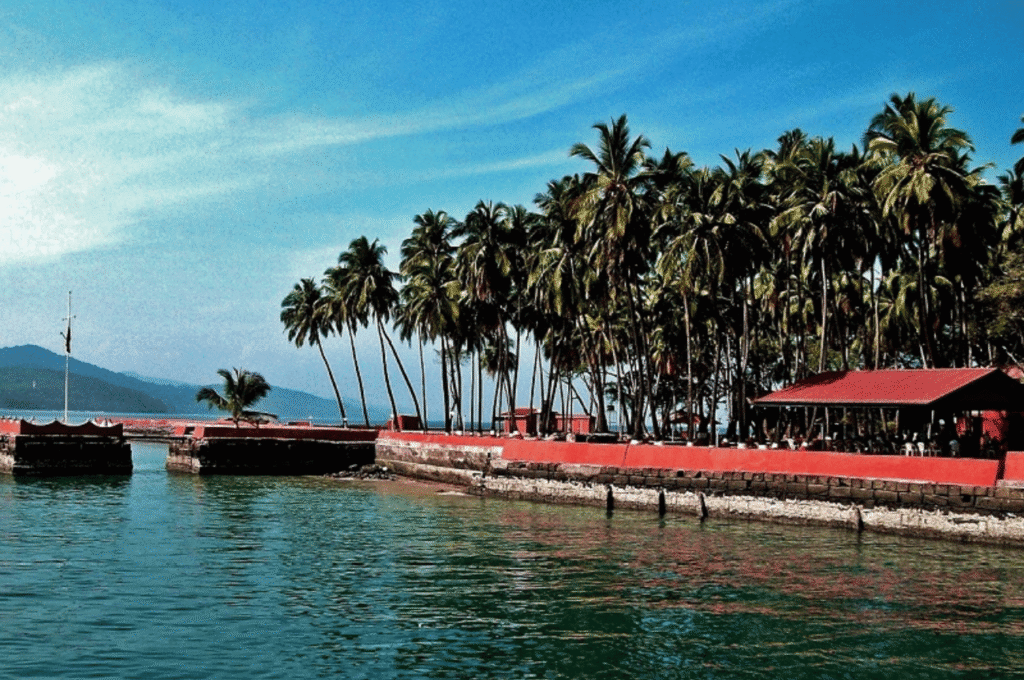
Step off the ferry at Ross Island, officially renamed Netaji Subhash Chandra Bose Island in 2018, and you’re immediately somewhere that doesn’t quite fit the usual Andaman experience. The sea is behind you, sparkling and ordinary. In front of you, banyan roots have split through the walls of a 19th-century church, spotted deer graze among the ruins of a colonial bakery, and a cemetery sits quietly at the edge of a forest that has been slowly erasing a British administrative town for the better part of eight decades. The whole crossing from Aberdeen Jetty in Port Blair takes about 10 minutes.
Most visitors spend under two hours here, see the church ruins and a few deer, then head back. They leave without knowing what they were actually looking at: the former nerve centre of British operations in the Andamans, occupied by Japanese forces in 1942, then abandoned entirely and handed back to the forest. That backstory is what makes Ross Island one of the most atmospheric half-days available from Port Blair, and it deserves more than a quick walk-through.
This guide covers everything you need before you go: the history that explains what you’re seeing, the specific attractions worth your time, ferry schedules and costs, the best season and time of day, and whether a private charter makes more sense than the shared boat queue. By the end, you’ll have a complete plan, not just a list of things to photograph.
The colonial story behind Ross Island, and why it was renamed
From British administrative hub to wartime ruin
The island takes its original name from Daniel Ross, a British marine surveyor who charted these waters in the early 19th century. Under British administration, this compact piece of land became the operational heart of the Andaman Islands: the Chief Commissioner’s House, administrative offices, a bakery, hospital, printing press, and a small European residential settlement were all packed into a space you can walk across in under 20 minutes. The British called it the “Paris of the East,” which tells you something about both the ambition of the settlement and the imagination of colonial administrators.
In March 1942, Japanese forces took control of the Andaman Islands, and the island’s role as an administrative centre effectively ended. After World War II, it remained largely uninhabited. Nature moved in with a speed and thoroughness that is genuinely striking to see today: the forest didn’t just grow around the buildings, it grew through them, over them, and in some cases used them as scaffolding. The specific moment of collapse, the 1942 takeover and subsequent abandonment, is what distinguishes these ruins from a generic heritage site. There is a precise reason the buildings look the way they do, and knowing that reason makes the walk considerably more interesting.
The 2018 renaming and what it signifies
On 30 December 2018, Prime Minister Narendra Modi officially renamed the island Netaji Subhash Chandra Bose Island. The date was deliberate: it marked the 75th anniversary of Bose hoisting the Indian tricolour in Port Blair on 30 December 1943, during the period of Japanese occupation when the Andaman Islands were briefly under the jurisdiction of the Provisional Government of Free India. The renaming was one of three announced that day, alongside Neil Island (now Shaheed Dweep) and Havelock Island (now Swaraj Dweep).
The new name carries genuine historical weight rather than being mere administrative formality. Bose’s connection to the Andamans sits alongside the islands’ existing association with the freedom struggle through the Cellular Jail in Port Blair. When locals and official communications use Netaji Subhash Chandra Bose Island, and when you see the name on signage at the jetty, that is the same place most people still refer to colloquially as Ross Island. Both names are correct; only one carries the full meaning of the location.
What you’ll actually see on Ross Island today
The ruins that make Ross Island worth the trip
The church ruins are arguably the most photographed structure on the island, and they earn that distinction. The walls are standing but roofless, and the banyan roots that have grown down through the masonry over decades give the space a texture that no restoration could reproduce. The Government House, or Chief Commissioner’s House, is another key stop: the scale of the original structure is still legible, and the forest reclamation at this site is particularly dramatic.
Beyond these two headline structures, the island has more to offer: the old bakery walls, the hospital remains, the printing press, and a small cemetery on the quieter side. What makes all of this distinctive is that these are not roped-off exhibits viewed from a distance. You walk among them, on uneven ground with tree roots underfoot, with no barriers between you and the stonework. For ruins of this age anywhere in India, that level of access is genuinely rare. Don’t miss the Japanese bunkers on the island’s periphery, which add a different historical layer entirely, World War II fortifications sitting within a British colonial ruin, both now being absorbed by the same forest.
The deer sanctuary, eco-museum, and Ferrar Beach
One detail that consistently surprises first-time visitors: spotted deer roam freely across Ross Island. They have become completely habituated to human presence and will graze within a few feet of visitors without concern. This isn’t a fenced enclosure; the deer simply live on the island and move through the ruins and forest as they please. Early morning visits, when the light is low and the deer are active, produce the most memorable encounters.
The eco-museum near the jetty entry point is worth 15 to 20 minutes of your time before you start the ruins circuit. It provides enough historical context to orient you, so that by the time you’re standing in the church ruins or the Government House, you understand what you’re looking at and why it was built. Ferrar Beach, on the island’s coastal edge, offers a quieter counterpoint to the ruins: a few minutes at the waterline, away from the main walking circuit. The island also hosts a light and sound show in the evenings, with a typical start time of around 5:30 PM and tickets priced at approximately ?300 per adult. Confirm current timings at the ticket counter on the day, as schedules shift by season and can be affected by weather.
How long does a visit actually take?
The 2-hour express route
If you’re combining Ross Island with North Bay on a combo boat ticket, your practical window at Ross Island shrinks to around two hours. That covers the church ruins, the Government House, and a walk through the deer area. You’ll get the atmosphere and enough of the main sights to leave with a clear impression. What it doesn’t cover is the eco-museum, the Japanese bunkers, the cemetery, or Ferrar Beach, and it doesn’t give you time to sit still anywhere.
For many visitors, this is an acceptable trade-off, especially if North Bay’s water activities are the primary draw for the day. Know what you’re getting before you book the combo ticket, rather than discovering mid-visit that you’ve run out of time.
The 3 to 4-hour half-day that does justice to the island
Three to four hours is the window that works properly for Ross Island. It gives you the eco-museum at the start for orientation, a thorough walk through all the main ruins without feeling chased by a clock, time at the Japanese bunkers and Ferrar Beach, and enough buffer to sit quietly in the church ruins or the Government House courtyard. That kind of stillness is actually what the island rewards most.
Plan your return ferry slot before you set off into the ruins. The last return ferry from Ross Island typically runs at around 4:00 PM, and missing it means arranging an unplanned private boat back to Port Blair. It’s solvable, but it adds cost and stress to what should be an uncomplicated half-day. If three to four hours on the island is your target, take the 8:30 AM or 9:30 AM ferry out and you’ll be back comfortably with time to spare.
Getting to Ross Island: ferries, schedules, and what it costs
Ross Island ferry timings from Aberdeen Jetty, Port Blair
The standard route to Ross Island runs from Aberdeen Jetty (also referred to as the Water Sports Complex Jetty) in Port Blair. Government and private shared ferries operate from approximately 8:30 AM through to early afternoon. The table below shows typical departure slots; verify these at the jetty counter before your visit, as timings can vary by season.
| Direction | Typical Departure Slots | Crossing Time |
|---|---|---|
| Port Blair ? Ross Island | 8:30 AM, 9:30 AM, 10:30 AM, 11:30 AM, 12:30 PM, 1:30 PM | 10, 15 minutes |
| Ross Island ? Port Blair | Running through to approximately 4:00 PM (last return) | 10, 15 minutes |
The island is most commonly reported as closed on Wednesdays. This is the single most frequently missed planning detail among first-time visitors: they book accommodation, arrange their Port Blair days, and then discover on arrival at the jetty that there are no services running. Confirm the closure policy at the jetty counter before finalising your visit date. Some sources suggest the Wednesday closure may have been revised in recent years, but the safest approach is to verify on the ground rather than rely on older listings.
Ticket options, costs, and the entry fee
The fare structure breaks down as follows. A basic round-trip shared ferry fare runs approximately ?300 to ?500 per person, while a Ross Island plus North Bay combo ticket typically costs ?750 to ?900 per person. A small island entry fee, usually in the range of ?20 to ?50 per adult, is charged separately at the island. Carry a valid government-issued photo ID, as registration may be required at the jetty or the island entry point.
For groups who prefer not to share a ferry, private group charters to Ross Island are available from Port Blair jetties at approximately ?5,000 for up to 10 people on a round-trip basis. Larger private day charter packages that include Ross Island as part of a broader itinerary are available at higher price points, with some operators offering full-day AC private charters for groups of up to 12 persons covering multiple stops including Corbyn’s Cove and other Port Blair area sites.
Why a private boat charter is worth considering over the ferry crowd
The reality of shared government ferries
Shared ferries are a workable option for solo travellers and budget-conscious visitors. They run regularly, the crossing is short, and the price is reasonable. The limitations become relevant when you’re travelling with a group, have a specific schedule, or want more from your day on the water than a fixed-order itinerary allows. Peak season mornings at Aberdeen Jetty can be crowded, and combo boat services operate on their own sequence regardless of your preferences.
The combo boat format, in particular, tends to compress the Ross Island visit because the schedule has to accommodate both stops. If your primary interest is the island’s history and ruins rather than North Bay’s snorkelling, you may find yourself cut short at the more interesting of the two destinations. This is a structural constraint of the shared format, not a criticism of any specific operator.
What a private day charter from Port Blair actually gives you
A private charter from Port Blair removes the fixed-schedule problem entirely. You depart when you want, stay at Ross Island for as long as the island warrants, and can build additional stops into the same day: North Bay, Corbyn’s Cove, or a secluded snorkelling spot that doesn’t appear on any standard combo ticket. The last-ferry anxiety disappears because your vessel operates on your schedule.
At Andaman Island Spirit Charters, we run day charter options out of Port Blair with Ross Island as a core stop within a tailored day itinerary. Whether you want to combine the island’s history with a snorkelling session, a coastal lunch at anchor, or a longer loop around the Port Blair marine area, we build the day around what actually interests your group rather than a pre-set sequence. For small groups, families, or couples who’ve already experienced the constraints of standard Andaman package tours, this is a meaningful upgrade. Get in touch with our team to discuss what a custom Port Blair day charter looks like for your travel dates.
The best time to visit Ross Island: season and time of day
October to March is the window that works best
The season that consistently delivers the best Ross Island experience runs from October through March. The weather is cooler, the sea between Port Blair and the island is calmer, and the light for photography in the ruins is at its most flattering, particularly in the cooler months of November through February. April and May remain viable if you can tolerate higher temperatures; tourist numbers thin out, which has its own appeal. The monsoon months from June through September bring rough seas and disrupted ferry services, making visits unreliable and sometimes impossible.
December and January sit at the sweet spot of the season: comfortable temperatures, reliable ferry services, and the ruins at their most photogenic. These are also the busiest months for Andaman tourism overall, which is worth factoring into your ferry timing decisions.
Take the first boat out if you can
The first departure of the day, around 8:30 AM, is consistently the quietest window across all seasons. The ruins are cooler, the deer are more active, and the soft directional light at that hour does something genuinely striking to the old church walls and the stone facades of the Government House. Early morning is also when the contrast between the forest and the colonial masonry is sharpest, which matters if you’re there with a camera.
Midday, roughly 11:00 AM to 2:00 PM, is the hottest and busiest period on Ross Island and the least rewarding window for both comfort and photography. The light goes flat, ferry-arrived crowds are at their peak, and the ruins lose something of their atmospheric quality when harshly lit and busy. Late afternoon offers a secondary window of good light and thinner crowds, but check your return ferry slot carefully before deciding to stay for it. The evening light and sound show at 5:30 PM requires a separate trip if you want to attend, as the day-visit ferry schedule wraps up well before then.
Practical tips for your Ross Island visit
What to carry, wear, and expect on the island
Food options on the island are very limited. A small refreshment point near the jetty area sells tea, snacks, and cold drinks, but there is no restaurant or reliable canteen circuit. Carry enough drinking water for your full visit, the island’s facilities are basic, and the heat between 10:00 AM and 3:00 PM is significant. Pick up snacks from Port Blair before you board the ferry, particularly for longer visits or groups with children.
Wear closed, comfortable footwear with grip. The terrain around the ruins involves uneven ground, exposed tree roots, and occasional stretches of loose stone. Sandals work for the jetty area but become a liability once you’re moving through the forest sections. Sunscreen and a hat are essential for the open sections during the warmer parts of the day. Photography is permitted across most of the island; check for any restricted signage near specific structures before shooting. Drone use requires special permission and is generally not straightforward to arrange for a standard tourist visit.
The Wednesday closure and last-ferry rule
Two things cause the most avoidable problems for Ross Island visitors. The first is the Wednesday closure: confirm this before your trip, not on the morning of. Check with your accommodation, your ferry operator, or directly at Aberdeen Jetty the day before. If your itinerary has flexibility, simply avoid planning Ross Island on a Wednesday and the issue doesn’t arise.
The second is the return ferry timing. Track the last return departure from Ross Island, around 4:00 PM for most services, and build your visit schedule backwards from it with a buffer of at least 20 to 30 minutes. Missing the last ferry means arranging a private boat back to Port Blair, which is possible but costs more and requires sorting out at the island rather than from the comfort of a plan made in advance. If you’re on a private charter with Andaman Island Spirit Charters or any private operator, this concern resolves itself: your vessel leaves when you’re ready, not on a fixed schedule.
Frequently asked questions about Ross Island
Is Ross Island the same as Netaji Subhash Chandra Bose Island?
Yes. The island was officially renamed Netaji Subhash Chandra Bose Island on 30 December 2018. Most visitors, ferry operators, and local guides continue to call it Ross Island in everyday usage. Both names refer to the same place.
What are the Ross Island ferry timings from Port Blair?
Ferries from Aberdeen Jetty in Port Blair to Ross Island typically depart at 8:30 AM, 9:30 AM, 10:30 AM, 11:30 AM, 12:30 PM, and 1:30 PM. The last return ferry from Ross Island runs at around 4:00 PM. Confirm timings at the jetty counter on the day of your visit, as they can vary by season.
Is Ross Island closed on Wednesdays?
The island has traditionally been closed on Wednesdays. This closure applies to regular ferry services and visitor entry. Some sources suggest this policy may have been updated, so verify with your ferry operator or at Aberdeen Jetty the day before your visit.
What is the entry fee for Ross Island?
A small island entry fee, typically ?20 to ?50 per adult, is charged separately from your ferry fare. Ferry tickets for a basic round trip cost approximately ?300 to ?500 per person; a Ross Island and North Bay combo ticket runs ?750 to ?900 per person.
Can I visit Ross Island and Smith Island on the same trip?
Ross Island and Smith Island are two separate destinations. Smith Island lies further north and is not part of the standard Ross Island day-trip route from Port Blair. If you want to combine multiple islands in a single day, a private charter is the most practical format, it lets you customise your itinerary rather than working around fixed combo-ticket schedules.
Plan the visit right and it delivers
Ross Island, officially Netaji Subhash Chandra Bose Island, is a short ferry ride from Port Blair but a world away from the standard Andaman beach experience. The colonial ruins absorbed by forest, the deer moving through the old Government House compound, the Japanese bunkers sitting quietly at the island’s edge: these layers of history compressed into a small space make this one of the most distinctive half-days available from Port Blair. But only if you give it the time it deserves.
The practical summary is straightforward. Visit between October and March, take the first boat out at 8:30 AM, give yourself at least three hours on the island, carry water and snacks, confirm the Wednesday closure before you commit to a date, and know your return ferry time before you start walking. If you want more flexibility than the shared ferry format allows, or if you want to fold Ross Island into a broader day on the water around Port Blair, a private charter is the cleaner option. You control the schedule, the duration, and what else the day includes.
Whether you take the public ferry or charter something more private, the island rewards visitors who arrive with some context. The ruins mean more when you know what they were, and when you understand the specific sequence of events that left them in the state you’re standing in. That’s exactly what this guide is for: arrive prepared, pace it properly, and Ross Island will give you one of the most memorable mornings available anywhere in the Andamans.